Employee benefits are useful, but some must be reported to HMRC. This guide explains what is a P11D form and what employers should do.
What does a P11D do?
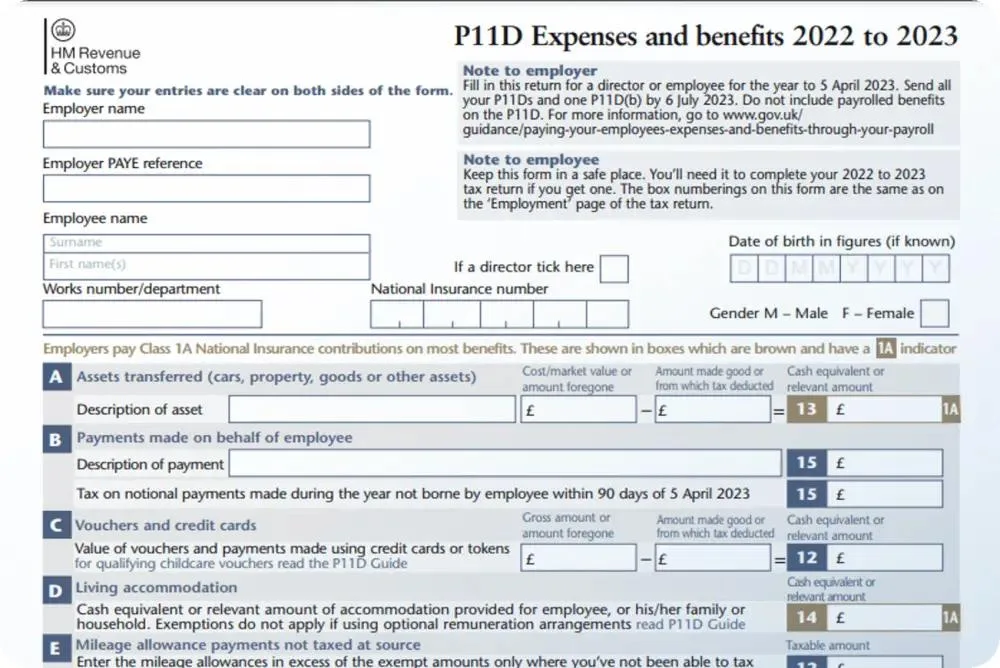
What is a P11D form is commonly asked about by employers offering additional benefits over their employees’ salary. It is required to declare certain expenses and benefits in relation to your employees or directors.
Within the tax year, you will declare benefits that your employees have received that haven’t already been taxed in their payroll. One return is generally required per employee who receives reportable benefits.
A P11D is a declaration of taxable benefits relating to work. HMRC will use this to verify your employee’s tax.
Which benefits may need reporting?
You may need to declare a benefit if it is not exempt and hasn’t been taxed within your payroll. Common examples include:
- Company Car – use for private purposes
- Fuel – for private travel
- Private medical/dental insurance
- Interest-free or low-interest loans to staff
- Vouchers/assets for personal use
- Providing accommodation
Depending on what the benefit is, there are different rules. For example, a work telephone may be different to a cash allowance. You should always check if you need to include anything. This is why knowing what a P11D form is important.
Some small gifts may be considered trivial benefits. Usually they will only be exempt if:
Need Help With Your Accounts Or Tax?
Whether you need support with self assessment, VAT returns, payroll, bookkeeping, CIS, company accounts or corporation tax, Asmat & Co Accountants can provide clear, practical advice for your business or personal finances.
- The cost of the benefit is £50 or less
- Not cash or cash vouchers
- Not a reward for work or performance
- Not part of the employment contract
Salary sacrifice schemes can affect how they’re taxed. Not all low-cost gifts will be tax-free.
P11D and P11D(b): What is the difference?
A form P11D is a declaration of the taxable value of benefits received by an individual. A P11D(b) is a return to declare the total amount of Class 1A National Insurance your employer owes.
P11D – Taxable benefits and expenses for an employee or director
P11D(b) – Class 1A National Insurance owed by the employer.
Class 1A National Insurance is a charge your employer will pay. It isn’t deducted from your employee’s wages.
A P11D(b) may still need to be submitted by your employer if they’ve received benefits that have been payrolled. Please check the rules for each tax year.
When do employers need to file?
The usual deadline to file a P11D is 6th July following the end of the tax year. You must provide a copy to each affected employee by this date. Class 1A National Insurance is due by 22nd July if paid electronically or 19th July if paid by cheque.
In 2025/26 the deadline was 6th July 2026. The next usual date to file for 2026/27 will be 6th July 2027.
Returns must be completed online either through HMRC’s PAYE Online service or using payroll software. Paper forms can only be submitted in limited circumstances, such as if your business has ceased trading or is digitally exempt.
What is changing from April 2027?
HMRC is bringing more benefits into payroll. From 6th April 2027, your employer should declare:
- Company Cars & Fuel
- Company Vans & Fuel
- Medical insurance
Most other benefits will become mandatory to declare in payroll from 6th April 2028. Loans and accommodation are currently not included.
Benefits that fall under the new system won’t need to be declared on a P11D or P11D(b). Income Tax and Class 1A National Insurance will be dealt with through your payroll. We recommend checking your payroll software.
How can Asmat Accountants help?
Our payroll services can help your business and ensure a smooth process at the end of the year.
We can:
- Help you determine which benefits are taxed and which are exempt.
- Keep track of your staff benefits.
- Calculate the values to declare.
- Prepare and file your returns on time.
- Ensure your payroll is ready for the 2027 and 2028 changes.
TOP TIP: Keep your benefit records up to date.
Create a list of your benefits throughout the year, including the employee’s name, type of benefit, date, and value. If anything changes, update this list. This will help at the end of the year.
If an employee asks what a P11D is, explain that it is a form for declaring benefits you received at work. Depending on their situation, they may pay P11D tax via their tax code or through HMRC.
Frequently asked questions
What’s a P11D form used for?
A form you give to HMRC to let them know about any taxable benefits or expenses your employer provided.
Do I need to send a P11D as an employer?
If all benefits have been taxed in payroll, then no, you do not need to provide a P11D, as they will have nothing to declare. However, you may need to provide a P11D(b).
Is a P11D the same as a P60?
No, a P60 is a summary of your employee’s earnings and taxes for the tax year. Whilst a P11D declares certain benefits and expenses from your employer.
Where can I get further guidance?
There are resources available online from HMRC to let you know the current rules and deadlines. If you are unsure, Asmat & Co Accountants can help.
Knowing what a P11D form is will help your employer correctly declare any benefits. If you keep accurate records and use payroll support, it will be easier to manage.
If you still need help keeping your business compliant? Get in touch with Asmat & Co Accountants!
Need Help With Your Accounts Or Tax?
Whether you need support with self assessment, VAT returns, payroll, bookkeeping, CIS, company accounts or corporation tax, Asmat & Co Accountants can provide clear, practical advice for your business or personal finances.